Thursday, 2 September 2010

my kimono sewing project


 .....12 meters of rinzu satin, tens of meters of hand stitches, hundreds of censored words, thousands of minutes at sewing, undo and re-sewing, I do not know how many drops of tears and sweat, and it is  First at the Vistula hand sewn tsukesage kimono :) although some elements require further amendments, I am proud of myself as a peacock :)

Includes gold obi with the motive stream ryusui, yellow obi-age, and date-eri and pale-green obi-Jima saganishiki.

Sunday, 1 August 2010

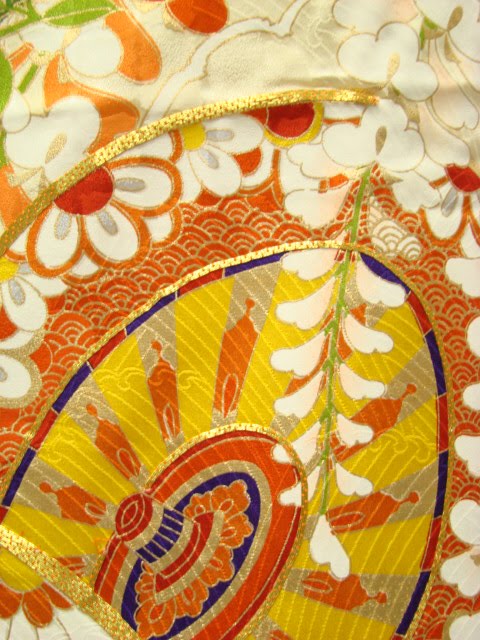
Fuji homoungi

This is the most ornate and impressive homoungi that so far I managed to spot and get it.
The auction of the kimono got involved my all undiscovered before  hunter instinct :)
Winning has a slightly salty taste, but heh.....
This rather monumental or dramatic theme, the garlands of wisteria (fuji) and integrated into the background of the wheel of the car used by the aristocrats in the old days-(goshoguruma).

Decorated yuzen is a technique, embroidered, a rare gem in my very modest collection of more everyday kimonos (komon, town wear).


Tuesday, 13 July 2010

Japanese treasure box-karako motif

I`ve  browsed many sites related to wafuku-(traditional Japanese costume) in search of information about kimonos and all that their tradition is related, etc. This allowed me to gain a little knowledge about the kitsuke rules (creation and arrangement of elements kimono art) and collect a database of observations and insights of classical motifs and designs presented to the kimono, obi belts, jackets haori whether  juban robes. A lot of them went into the list of my favorites, by an interesting subject matter, technique, presentation and accuracy or exotic colors.
One of the classic, but quite exotic designs used in creating  wafuku is  theme of karako-Chinese child, I called the Chinese, plump toddler, with a shaven head. These are usually painted in the yuzen technique, also tend to be woven and embroidered.
The biggest, that I know,  online shop, where you can watch (and buy if the purse permits) thousands of kimonos, obi, haori etc. is ICHIROYA. I found there the largest collection of hilarious karako. The most often mapped to nagoya obi belts, but I found them both on several formal kimono with crests- kurotomesode, whether susohiki -spectacular kimonos worn by geisha but of course on  the childish kimono whether male haori. 


Zdjęcia opublikowane za zgodą właściciela Ichiroya.
Thank you Ichiro san!


Wednesday, 2 June 2010

Zostałam laureatką....


darmowy hosting obrazków 


...wyróżnienia  w konkursie na projekt kimona inspirowanego twórczością Fryderyka Chopina w krakowskim muzeum sztuki japońskiej Manggha!
Zdjęcia projektu niestety nie mam, robiłam go wielkim pośpiechu by zdążyć przed ostatecznym terminem wysyłania zgłoszeń. Szkoda, ale trudno. Projekt jest w Japonii, nie sądziłam, że będzie oceniany przez takie szanowne grono specjalistów od technik związanych z barwieniem jedwabiu.
Nie przyznano pierwszej nagrody, ponieważ żaden z projektów nie odpowiadał, dostatecznie wymogom projeku kimona tworzonego w technice yzuen. Jednak i tak puchnę z dumy, bo robiłam to po raz pierwszy w życiu wkładając w to całe moje serce i wiedzę na temat specyfiki wzornictwa japońskiego.
Zaprojektowałam szare tsukesage z motywem klawiatury fortepianu wystylizowanej  w klasyczny motyw wijącego się strumienia tzw. ryusui oraz motywem gałązek wierzby  tzw. yanagi  spływających z ramion w dół.
Fajne doświadczenie i trudne, bo od dawna rysunek nie jest moją mocną sprawą, a nie podjęłabym się projektowania w jakimś programie graficznym:)


Monday, 31 May 2010

how to sew a kimono?

I don`t know yet!!! I`ll found out immediatelly, cause the bautiful bolt of rinzu silk is just arrived to my home i n parcell from Japan.


Wiadomo, jedwab artykuł luksusowy i niezwykły, reklamować nie trzeba, ale okazuje się, że ma tak wiele swoich odmian i rodzajów, że mówiąc o jakiejś tkaninie po prostu jedwab, to za mało.
Ten który najbardziej robi na mnie wrażenie to własnie rinzu, zwany równiez jedwabnym adamaszkiem, gdzie wzór jest formowany podczas tkania, może być dodatkowo malowany  (yuzen), farbowany (katazome, shibori) itp. Ta belka rinzu, która przywędrowała do mnie z Osaki jest malowana w technice yuzen, wszystkie kontury są jeszcze machnięte złotym kolorem.
Wszystkie materiały na kimona są tkane właśnie w takich wąskich 37-centymetrowych zazwyczaj belkach po 10-12 metrów. Przeżyłam  niezłą zabawę z pocięciem jej na odpowiednio  długie  panele, tak by układ wzorów odpowiadał klasycznemu rozmieszczeniu elementów dekoracyjnych na tzw. tsukesage, czyli kimonie wizytowym, na którym wzór jest usytuowany na dole, na plecach z prawej strony i prawym rękawie oraz lewej piersi, przy czym to jest nie kontynowany przez szwy paneli. 
Zadrżałam  z nożycami w reku, ale raz kozie smierć, teraz pewnie będę drżeć, kiedy w końcu uda mi się zasiąść igłą w ręku do szycia pod okiem specjalistki. Ale o tym nastepnym razem... 

Tuesday, 4 May 2010

my first bingata like kimono

I am fell in love with these springy and aiy patterns. Oryginal bingata are so elaborated and sophisticated that I`m able to get only bingata style komon only, but it is enough to be pleased and happy with their charm.


Monday, 1 March 2010

I did it


....with dediction to Shino San.

It is my first kimono!!!!!!

Kimono made of silk with damask weave, woven into a pattern of cherry blossom, partly dyed shibori technique (looped). It is a type of kimono komon (fine pattern evenly distributed over the entire surface). Comes with a silk belt nagoya obi, pattern seigaiha (wave of concentric arcs).

* label on the pillow nicely complements the all ensemble :D


first kitsuke lesson